Pool Water Chemistry 101: Ideal Levels for North Texas Pools

Austin Andrews
Founder, True Texan Pools
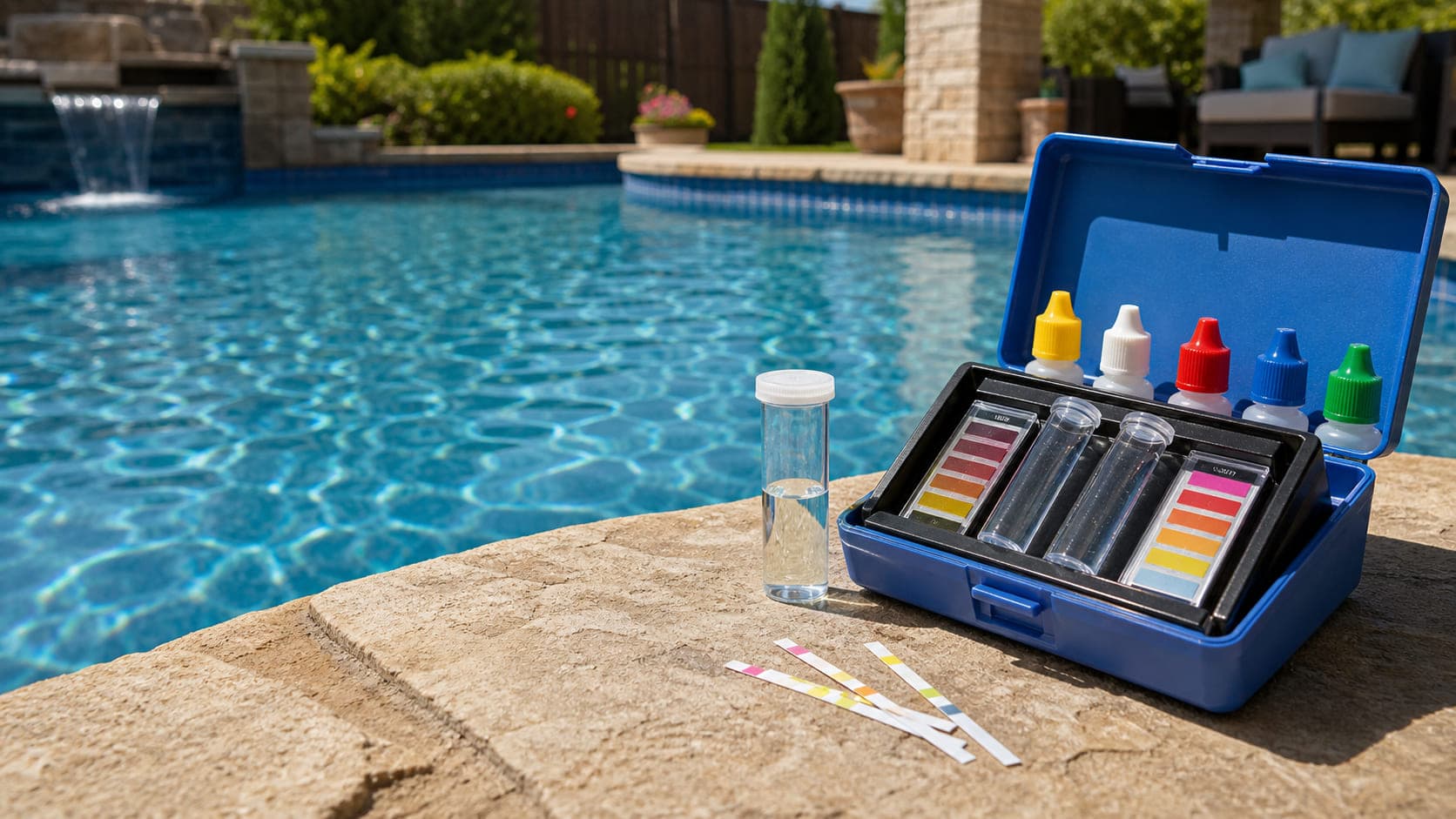
Pool chemistry sounds intimidating, but it really comes down to a handful of numbers and how they affect each other. Get those numbers into range and your water stays clear, your equipment lasts, and swimming is comfortable. Let them drift and you get algae, cloudy water, stinging eyes, or scale on your tile. Here is what every Plano pool owner should know, including the North Texas wrinkle that catches a lot of people off guard: calcium quietly climbs season after season.
The five numbers that matter
Forget the dozens of products on the store shelf for a moment. Healthy pool water is really just these five readings sitting in their proper ranges:
| Reading | Ideal range | What it controls |
|---|---|---|
| Free chlorine | 2 to 3 ppm (1 ppm floor only if unstabilized) | Sanitizer that kills algae and bacteria |
| pH | 7.4 to 7.6 | How well chlorine works and how the water feels |
| Total alkalinity | 80 to 120 ppm | Buffer that keeps pH stable |
| Calcium hardness | 200 to 400 ppm | Protects surfaces; too high causes scale |
| Cyanuric acid | 30 to 50 ppm | Shields chlorine from sunlight |
These are not house rules. Those ranges follow the CDC’s guidance for home pools for sanitizer and pH, and the ANSI/APSP/ICC-11 water quality standard and the Pool & Hot Tub Alliance’s water chemistry guidelines for alkalinity, calcium, and stabilizer. The sanitizer-specific alkalinity split below comes from the PHTA Recreational Water Quality Committee’s Total Alkalinity in Pool and Spa Water, which is the only one of the three that addresses electrolytic chlorine generators directly. Where we narrow a published range, we say so and explain why.
Free chlorine: the sanitizer
Chlorine is what keeps your water safe. It kills bacteria and algae and breaks down the organic gunk that swimmers, leaves, and storms bring in. The CDC recommends a minimum of 1 ppm free chlorine in a pool at all times, and at least 2 ppm in a pool that uses cyanuric acid, which covers nearly every pool in this area, including yours if you run stabilizer or use dichlor or trichlor tablets. For a residential pool in this climate we aim for 1 to 3 parts per million, treating the CDC minimum that applies to your pool as the floor you never drop below rather than the number you target. If you are stabilized, that floor is 2 ppm, so the working range is really 2 to 3.
In a Plano summer, lean toward the high end. Heat and sunlight burn chlorine off quickly, so a level that looked fine in the morning can be near zero by evening. The most common cause of a green pool is simply chlorine that dipped too low for a day or two. If that has already happened to you, our green-to-clean guide covers the recovery.
pH: the master dial
If you only learn to manage one number, make it pH. It controls how effectively your chlorine works and how the water treats your equipment and your swimmers. The CDC puts the safe band at 7.0 to 7.8, and the two directions fail differently: as pH climbs, chlorine gets worse at killing germs, especially above 8.0, while below 7.0 chlorine actually kills faster but the water starts eating your pipes and equipment. We target 7.4 to 7.6, near the middle, because it leaves room to drift in either direction between weekly visits without leaving the safe range.
- pH too low (acidic, below 7.2): the water corrodes metal fittings, heater parts, and pump seals, and it stings eyes and skin.
- pH too high (above 7.8): chlorine becomes sluggish and inefficient, water turns cloudy, and scale starts forming, a real risk once calcium has built up.
Here is the part people miss: chlorine and pH are linked. At a pH of 8.0, a big chunk of your chlorine is effectively asleep and barely sanitizing. You can pour in chlorine all day, but until you bring pH back down it will not do its job. Fix pH first, then judge your chlorine.
Total alkalinity: the buffer
Total alkalinity is the shock absorber for pH. The ANSI/APSP-11 standard allows a wide band, 60 to 180 ppm, but narrows the ideal depending on which sanitizer you use: roughly 80 to 100 ppm for salt systems and liquid or cal-hypo chlorine, which push pH up, and 100 to 120 ppm for tablets and dichlor, which pull it down. Keep it in the 80 to 120 ppm range that spans both and your pH stays put. Let it drop too low and pH starts bouncing around unpredictably with every rain and every chemical addition, which is called pH bounce. Always set alkalinity before you fine-tune pH, because alkalinity is what holds pH steady.
Calcium hardness and the North Texas problem that creeps up on you
This is the one that surprises new DFW pool owners. The North Texas Municipal Water District, which supplies much of Collin County, describes its treated water as moderately hard and attributes the mineral content to Lavon Lake. Moderately hard sounds harmless, and for drinking water it is. For a pool it compounds: every time you top off after evaporation, which is constantly in our summers, the water evaporates and the calcium stays behind. Do that for a few seasons and the number only goes one direction.
Target 200 to 400 ppmcalcium hardness, which is the Pool & Hot Tub Alliance’s recommended range for concrete and plaster pools. (The full tolerated band is much wider, 150 to 1,000 ppm, with 150 ppm as the floor for any pool. The published guidelines split calcium hardness by vessel, pools versus spas, not by surface material, so do not aim a vinyl-liner or fiberglass pool at a spa range.) The two failure modes:
- Too low: the water gets aggressive and pulls calcium out of plaster, grout, and concrete surfaces, etching them over time.
- Too high, combined with high pH: calcium falls out of solution and forms that crusty white scale on your tile line and inside your heater and pipes. This is the most common chemistry complaint we see in Plano.
Watch the tile line for early scale
A faint white, chalky crust forming just above the waterline is your early warning that calcium and pH are climbing together. Catch it there and a chemistry adjustment fixes it. Ignore it for a season and you are looking at a bead-blasting or acid treatment to get it off. Hard water is not a problem you solve once, it is one you manage continuously.
Cyanuric acid: sunscreen for your chlorine
Cyanuric acid, also called stabilizer or conditioner, is the unsung hero of a Texas pool. Without it, the intense summer sun destroys free chlorine within hours. With the right amount, your chlorine lasts dramatically longer through the day. Target 30 to 50 ppm, which is the ideal range in the ANSI/APSP-11 standard. That same standard sets a hard ceiling of 100 ppm, and in our experience a Texas pool that reaches it is already losing the fight against algae.
But more is not better. This is the single most misunderstood chemical in pool care:
- Too little (below 30): the sun burns your chlorine off by midday and you fight a losing battle against algae.
- Too much (above 60 to 80): the more stabilizer in the water, the higher you have to push your chlorine to get the same sanitizing power. Let it climb too far and the chlorine level you would need becomes impractical to hold, so algae can take off even when your test still shows some chlorine present. The fix is usually diluting the water by draining and refilling part of the pool.
Cyanuric acid creeps up over time, especially if you use stabilized chlorine tablets, because every tablet adds a little more. It is worth testing a few times a season so it does not sneak past the useful range.
The order you adjust things in
Chemistry is connected, so the sequence matters. Chasing one number without the others in place just creates a loop. Work in this order:
| Step | Adjust | Why first |
|---|---|---|
| 1 | Total alkalinity | Stabilizes pH so the next steps hold |
| 2 | pH | Makes chlorine effective and protects equipment |
| 3 | Calcium hardness | Prevents etching and scale |
| 4 | Cyanuric acid | Protects chlorine from sunlight |
| 5 | Free chlorine | Now it can actually do its job |
Add chemicals one at a time, and slowly
Never mix pool chemicals together or pour several in at once. Add one, let the pump circulate it for a few hours, then re-test before adding the next. Dumping chemicals in quickly is how people overshoot, cloud the water, or create dangerous reactions. Slow and measured wins every time.
How often to test
The CDC standard is to test free chlorine and pH at least twice a day, and more often when a number of people are swimming. That is written for the worst case, and almost no homeowner does it. What we actually see work in a Plano summer is testing chlorine and pH every couple of days, plus after every storm and every heavy pool party, which are the two events that most often start a bloom. Check alkalinity, calcium, and cyanuric acid every couple of weeks. In the cooler months you can ease off, since algae growth and chlorine burn-off slow down with the temperature. Just know that the further you stretch it, the more you are relying on your stabilizer and your last visit to hold the line for you.
If keeping five numbers in range every week sounds like a part-time job, that is essentially what it is in our climate, and it is exactly what a weekly service plan takes off your plate. We test and balance every visit and leave you the readings in a photo report, so the chemistry is handled and you just get to swim. You can compare weekly and biweekly schedules here or reach out for a quote.
Frequently Asked Questions
What is the ideal chlorine level for a pool?
For practical purposes, 2 to 3 parts per million. The CDC sets the floor at 1 ppm, but at least 2 ppm if the pool uses cyanuric acid, and nearly every North Texas pool does, so 2 ppm is the number that actually applies to you. In the peak of a Texas summer, aim for the higher end because heat and sunlight burn chlorine off quickly.
What should pool pH be?
Pool pH should sit between 7.4 and 7.6. That range keeps chlorine working efficiently, protects your equipment from corrosion or scale, and keeps the water comfortable for swimmers.
Why does North Texas water cause scale on my pool?
The North Texas Municipal Water District describes its treated water as moderately hard, meaning it carries dissolved calcium. In a pool that compounds: every summer top-off after evaporation leaves the calcium behind, so hardness only climbs. When it gets too high and pH drifts up, those minerals fall out of solution as white scale on tile and surfaces. Keeping calcium and pH in range prevents it.
Ready to stop thinking about your pool?
True Texan Pools keeps your water swim-ready year-round across Plano and all of DFW. Clear pricing, no contracts, and a photo report after every visit. Austin handles every job personally.
Keep reading
Salt Water Pool Maintenance in North Texas: What Nobody Tells You
Salt pools are not chlorine-free and not lower maintenance. They trade weekly chemical handling for a standing requirement to control pH and keep the cell clean, which is harder here than most places.
Weekly vs. Biweekly Pool Service: What Plano Homeowners Need
Biweekly service looks cheaper on paper, but in the Texas heat it often costs more in chemicals and recovery. Here is how to decide which schedule your Plano pool actually needs.